Introducing the Palace Architecture Presentation: A Foundation for Professional Communication
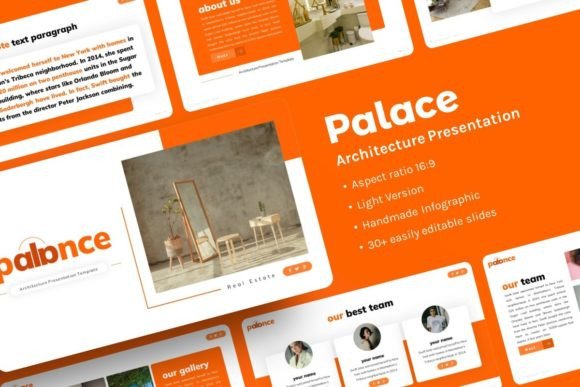
In the world of business, design, and creative work, the ability to present ideas clearly and compellingly is a foundational skill. The right presentation template does more than just decorate slides; it structures your narrative, elevates your content, and builds a professional rapport with your audience. The Palace Architecture Presentation is engineered to serve as this critical foundation. It is not merely a set of slides but a structured visual system designed for deep customization, enabling professionals to communicate complex concepts with clarity and aesthetic cohesion.
Its core purpose is to replace the often chaotic and time-consuming process of building a presentation from scratch. By providing a complete, architecturally-inspired framework—complete with master slides, a unified design language, and placeholder logic—it allows you to focus entirely on your message and data. This shifts the workflow from design assembly to content strategy and refinement.
Integrating the Template into Your Professional Process
The utility of the Palace Architecture Presentation extends across the entire lifecycle of a project or initiative. Its integration points are multiple, fitting naturally into common planning, execution, and review phases.
Strategic Planning and Conceptualization
Before a project even begins, the template can serve as a powerful planning tool. Its handcrafted infographics and structured layouts force a discipline of thought. For a creative agency pitching a new campaign, or a startup outlining its business model for investors, populating the template's slides becomes an exercise in refining the concept itself. The process of deciding which slide to use for the market analysis, which infographic best illustrates the user journey, and how to sequence the narrative fosters a clearer strategic vision. This early use ensures that the final presentation is not just a delivery mechanism, but a documented record of the project's foundational logic.
Execution and Dynamic Development
During active project work, the template functions as a living document. Its easy-to-customize contents and resizable, editable graphics mean it can evolve alongside the project. A company profiling its growth can update financial charts monthly. A photographer building a portfolio can swap in new images as shoots are completed. The drag-and-drop picture placeholder system is particularly valuable here, removing technical barriers and keeping the presentation current with minimal effort. This dynamic use supports not just final delivery, but ongoing internal reviews, stakeholder updates, and iterative creative processes.
Final Delivery and Beyond
For the crucial moment of delivery—the client pitch, the investor meeting, the portfolio review—the template ensures consistency and quality. The pixel-perfect illustrations and master-slide-based design guarantee that every slide, whether the first or the thirtyth, maintains a professional and cohesive look. This eliminates last-minute formatting panic and allows the presenter to focus on performance. Furthermore, the included documentation file provides a reference for future use, making the template a reusable asset. After the presentation, the .PPTX file itself becomes a documented archive of the project, useful for future proposals, case studies, or internal training.
Practical Implementation and Workflow Synergy
Adopting the Palace Architecture Presentation into your workflow requires minimal technical overhead but offers maximum strategic benefit. The key is to view it as a system, not just a template.
Start by reviewing the full 30-slide suite. Understand the purpose of each master slide layout—the title slides, the content dividers, the comparison layouts, the infographic pages. Map your own narrative or data points to these existing structures. This mapping exercise is the first practical step, aligning your content with a proven visual flow.
Next, leverage the included asset guidance. The template specifies the use of the Mulish font, a clean and versatile typeface available freely. It also directs users to high-quality, license-free image sources like Unsplash, Pixabay, and Pexels. This guidance streamlines asset gathering, ensuring all visual elements—typography, icons, photography—remain within a harmonious and legally safe ecosystem. While the demo images are for preview only, this directive points you toward a vast repository of professional imagery that can be integrated via the drag-and-drop placeholder system.
Compatibility and Collaborative Use
The template is delivered as a standard PowerPoint .PPTX file, ensuring compatibility with the most common presentation software globally. This makes it ideal for collaborative environments. A team can work on a single file; a designer can customize the vector icons and graphics in PowerPoint; a marketer can populate the text and image placeholders. The master slide foundation ensures that even if individual slides are edited, the core design principles like color scheme, font hierarchy, and spacing remain intact, enforcing brand or personal consistency across all contributors.
Long-Term Value and Adaptability
Think of this template not as a one-time purchase but as a core component of your professional toolkit. Its broad suggested use cases—from corporate business and creative agency profiles to personal portfolios and pitch decks—mean it can be adapted for nearly any communication need that arises. By mastering this single system, you build efficiency over time. You learn its quirks, know which infographic to modify for a particular data set, and develop a faster production rhythm. This long-term use turns a presentation task from a recurring chore into a streamlined, predictable, and quality-controlled process.
Observations for Optimal Results
To extract the maximum value from the Palace Architecture Presentation, a few practical observations are worth noting. First, customization is the goal, but structure is the friend. Resist the urge to completely break the master slide layouts initially. The power of the template lies in its underlying architecture; modify contents and graphics within that framework to maintain the professional polish it provides.
Second, use the documentation file. It will clarify the design logic, explain how to edit the vector icons, and provide tips for resizing graphics without losing quality. This is an often-overlooked resource that can prevent frustration and save hours.
Finally, integrate your external tools seamlessly. When sourcing images from Unsplash or Pexels, download them in resolutions appropriate for the placeholder dimensions. When preparing data for the infographics, simplify it to match the visual storytelling capacity of the charts provided. The template is a bridge between your raw content and your audience; your preparatory work on that content determines how strong that bridge will be.
In essence, the Palace Architecture Presentation is more than a collection of slides. It is a process-enabling tool. It fits into workflows before, during, and after key professional milestones. It interacts smoothly with common software, free asset libraries, and collaborative teams. By providing a robust, editable, and aesthetically coherent framework, it allows professionals, creators, and entrepreneurs to dedicate their energy where it matters most: to the clarity of their idea, the strength of their story, and the impact of their communication.